A Contemporary Abstract Journey Through Banaras, Where Color Becomes Prayer and Silence Becomes Light
By Artist Dhirendra Sisodia & Artist Amit Kumar Mehta
There are cities that exist on maps, and then there are cities that exist within the soul. Banaras belongs to the second kind. It is not merely a destination resting beside the sacred river; it is a timeless vibration, a breathing hymn, an endless dialogue between life and eternity. Every stone of its ghats carries stories, every wave of the Ganga reflects centuries of devotion, and every dawn arrives like a spiritual awakening painted across the sky. In this contemporary abstract artwork by Artist Dhirendra Sisodia and Artist Amit Kumar Mehta, Banaras is not represented through realism alone. Instead, it is felt through movement, through texture, through layered emotions flowing across the canvas like sacred water itself.
This acrylic painting on canvas is not simply a visual composition. It is an experience of rhythm, silence, devotion, chaos, birth, liberation, and peace woven together through color and abstraction. The painting speaks in a language beyond words, where every stroke carries memory and every texture holds an inner prayer. The artists do not attempt to recreate the ghats as they physically appear; rather, they reveal what Banaras feels like when one stands at the edge of the river and listens deeply to existence itself.
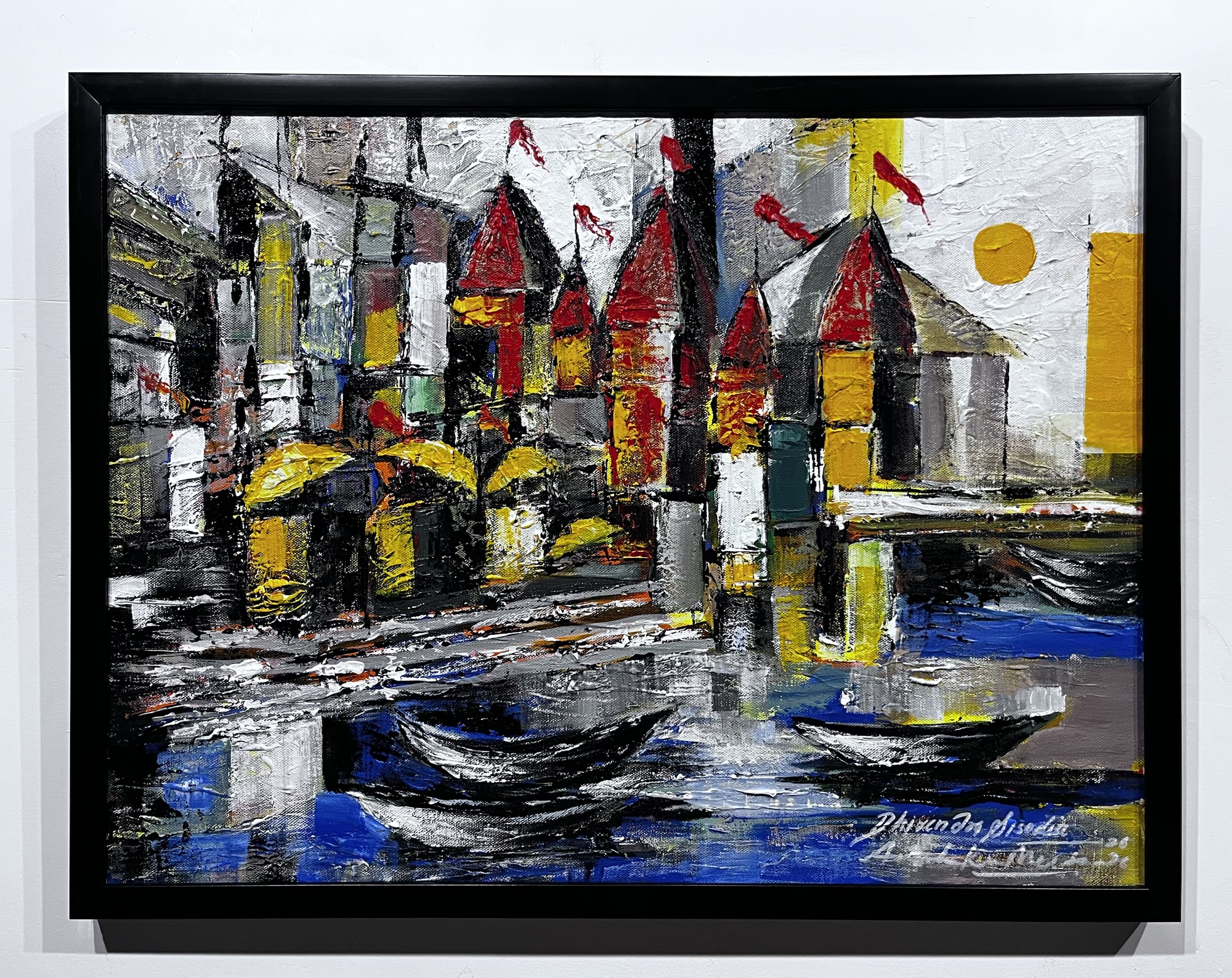
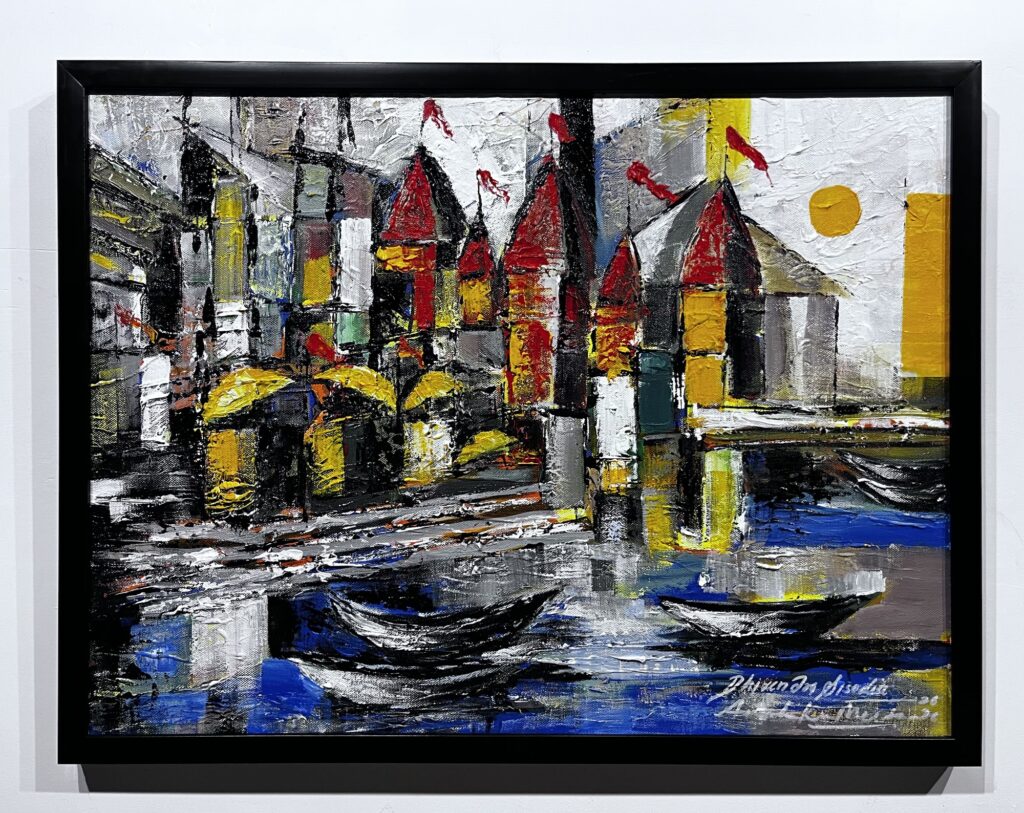
At first glance, the painting appears alive with intense movement. Bold reds rise like temple spires against muted greys and whites. Deep blues flow across the lower surface like the eternal Ganga carrying reflections of the sky and human consciousness together. Black vertical forms stand with immense strength, like ancient pillars of time witnessing generations come and go. The composition feels fragmented yet complete, chaotic yet peaceful, abstract yet spiritually intimate. This duality is the true spirit of Banaras.
Banaras has always existed between opposites. It is where birth and death sit beside one another without fear. It is where celebration and mourning share the same riverbank. It is where fire becomes liberation and ashes become eternity. In this artwork, these contradictions dissolve into harmony. The painting does not separate joy from sorrow or life from moksha. Instead, it allows them to flow together naturally, just as the Ganga accepts everything without judgment.
The process of creating this painting itself mirrors the philosophy of the city. Built layer by layer using acrylic on canvas, the artwork carries visible textures that reveal the emotional journey of the artists. Each layer was not merely applied technically but emotionally. Colors were not chosen for decoration; they emerged from inner states of feeling. The thick palette knife textures create depth similar to the layered history of Banaras itself. Beneath every visible surface lies another hidden emotion, another memory, another silence.
Artist Dhirendra Sisodia brings a powerful sense of structure and intensity into the composition. His treatment of architectural abstraction transforms the temples and ghats into emotional symbols rather than literal forms. The rising red shapes resemble sacred flames, temple peaks, and spiritual ascension all at once. They pull the viewer upward, creating a feeling of transcendence. Through bold contrasts and expressive layering, he introduces energy that feels almost musical, like the sound of temple bells echoing through misty mornings.
Artist Amit Kumar Mehta, on the other hand, infuses the canvas with emotional fluidity and meditative depth. His understanding of color relationships and atmospheric silence allows the painting to breathe. The blues and whites do not remain static; they flow like consciousness itself. There is softness hidden beneath the dramatic textures, a peace quietly emerging from within the abstraction. His contribution creates emotional balance, allowing the painting to become not only expressive but spiritually reflective.
Together, the collaboration becomes more than two artistic styles merging. It becomes a conversation between two inner worlds connected by one sacred vision. The painting feels united because both artists approach Banaras not only as painters but as seekers. Their shared emotional connection with the city transforms the canvas into a spiritual landscape rather than a physical one.
One of the most striking aspects of this artwork is its treatment of color psychology. The red tones dominate sections of the painting with fierce emotional presence. In Indian spirituality, red symbolizes life force, devotion, energy, and sacrifice. Here, the reds appear almost like burning consciousness emerging through layers of grey existence. They represent the eternal flame of Banaras, the fire that destroys illusion and awakens truth. Yet these reds are balanced by expansive whites and muted tones that introduce calmness and surrender.
The blues flowing across the lower part of the composition carry immense emotional resonance. These are not ordinary blues. They feel deep, sacred, reflective. They mirror the spiritual depth of the Ganga at twilight, where the river becomes less water and more eternity. Within these reflections lie human emotions, longing, peace, surrender, hope. The boats floating silently in the foreground symbolize life itself. Small, temporary, drifting through the vastness of time and existence. Yet despite their fragility, they continue forward.
The abstraction in the painting allows viewers to discover their own meanings within the work. Some may see spiritual liberation. Others may feel nostalgia, silence, or emotional healing. This openness is what gives contemporary abstract art its enduring power. Unlike realism, abstraction does not dictate emotion. It invites emotion. It creates space for personal reflection. The painting becomes a mirror where viewers encounter not only Banaras but themselves.
Texture plays a central role in communicating this emotional depth. The thick acrylic layers create a tactile presence that almost resembles weathered walls, ancient temple surfaces, flowing water, and cracked memories. The palette knife work introduces rawness and honesty. Nothing appears overly polished or artificial. The surface feels alive, carrying imperfections similar to human life itself. These textures remind us that beauty often emerges not from perfection but from experience.
Light within the painting also carries symbolic meaning. The golden-yellow circular form appearing near the upper right section resembles the sun, but it also feels spiritual, like a divine eye watching over existence. It radiates warmth amid the dense abstraction. In Banaras, sunlight holds sacred significance. Morning light touching the river is seen as a blessing, a moment of spiritual purification. The artists capture this feeling not literally but emotionally through glowing accents emerging from layered darkness.
There is also a remarkable sense of rhythm throughout the composition. The painting moves like music. Vertical structures rise and fall like chants. Reflections ripple like melodies. Colors collide and dissolve like human emotions during meditation. This rhythmic movement reflects the living heartbeat of Banaras itself. The city never truly sleeps. Its rhythms continue endlessly, through prayers, cremation fires, boat songs, temple bells, footsteps on stone ghats, and silent conversations between humans and the divine.
What makes this artwork deeply contemporary is its ability to merge tradition with modern emotional language. Banaras is ancient, yet the painting speaks in a highly modern visual vocabulary. Instead of detailed realism, the artists use abstraction to communicate timeless truths. This approach allows younger audiences and contemporary art lovers to engage with spiritual themes in a fresh and emotionally accessible way. The painting respects tradition without becoming trapped by it.
In many ways, this artwork challenges viewers to slow down. Modern life often demands speed, distraction, and surface-level experiences. But Banaras teaches patience. It teaches observation. It teaches surrender. Similarly, this painting cannot be fully understood in a single glance. The longer one looks, the more emotions emerge from beneath the layers. Hidden textures appear. Colors begin to converse. Silence becomes visible. The artwork rewards contemplation.
The collaborative energy between Artist Dhirendra Sisodia and Artist Amit Kumar Mehta also reflects a deeper artistic philosophy, that art is not competition but shared creation. Their combined vision demonstrates how two distinct artistic voices can unite harmoniously while maintaining individuality. This balance mirrors the spiritual essence of Banaras itself, where countless beliefs, rituals, and identities coexist beside one sacred river.
Emotionally, the painting carries a profound sense of moksha, liberation from attachment and illusion. Yet this liberation is not portrayed through emptiness alone. It emerges through fullness, through intense emotional experience transformed into peace. The chaotic textures gradually dissolve into calm reflections. The dense structures open into spaciousness. Darkness gives birth to light. This emotional transformation mirrors the spiritual journey of human existence.
There is a quiet humanity hidden within the abstraction as well. Though no detailed human figures dominate the canvas, human presence is everywhere. It exists in the boats, in the reflections, in the architecture, in the flowing movement of color. The painting reminds us that Banaras is ultimately about people seeking meaning, pilgrims searching for peace, souls searching for liberation, artists searching for expression.
Acrylic as a medium plays an essential role in achieving this emotional intensity. Its versatility allows the artists to build layers rapidly while preserving spontaneity. Unlike slower mediums, acrylic responds immediately to gesture and emotion. This immediacy gives the painting raw authenticity. Every stroke feels connected to a real emotional moment during creation. The layering process also mirrors spiritual accumulation, experiences building over time until they become wisdom.
The black frame surrounding the artwork enhances its dramatic presence. It acts almost like a silent boundary between the material and spiritual worlds. Inside the frame, colors flow freely like consciousness escaping limitation. The contrast between the dark border and luminous interior intensifies the emotional impact, drawing viewers inward toward contemplation.
Ultimately, this painting is not about explaining Banaras. Banaras cannot truly be explained. It can only be experienced. Through abstraction, texture, rhythm, and emotional color, Artist Dhirendra Sisodia and Artist Amit Kumar Mehta create a visual meditation on existence itself. Their work transforms canvas into a sacred space where viewers can pause, reflect, and reconnect with deeper emotions often forgotten in everyday life.
The painting reminds us that life is constantly flowing, just like the river. Moments pass, forms change, bodies disappear, but something eternal continues beneath it all. In the reflections of blue water, in the rising temple forms, in the burning reds and silent whites, we witness not only the spirit of Banaras but the rhythm of human existence. Birth, devotion, struggle, peace, surrender, liberation, all coexist within one flowing reality.
This artwork stands as a contemporary spiritual expression where abstraction becomes prayer and color becomes emotion. It invites viewers not merely to observe but to feel. To remember. To surrender. To listen to the silence beneath the noise of the world.
And perhaps that is the true essence of Banaras. Not a city of endings, but a city where every ending quietly transforms into light.