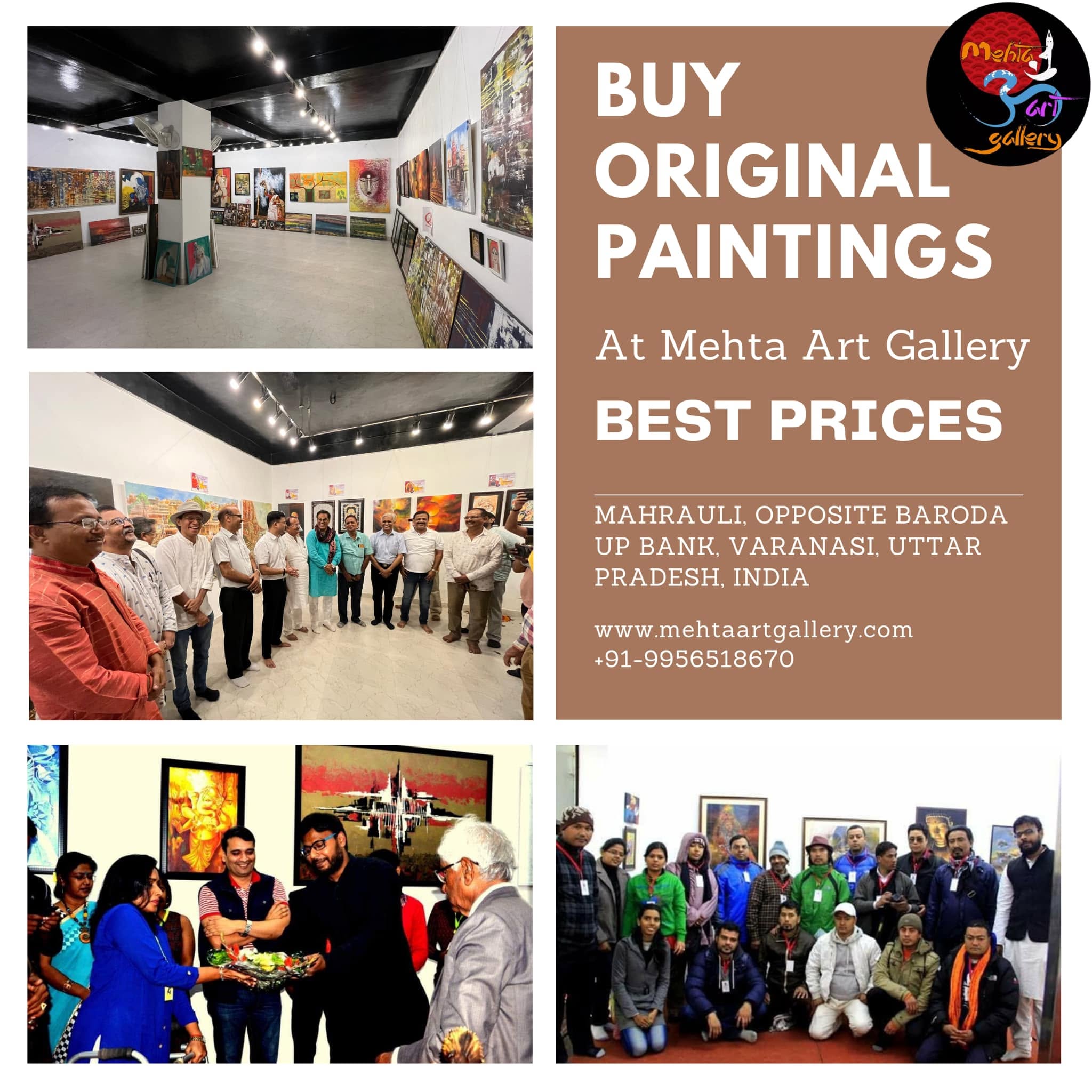
Visit Mehta Art Gallery

In a world brimming with noise, deadlines, and distractions, finding moments of true peace can feel like chasing a distant dream. Yet, within the quiet halls of an art gallery, surrounded by colors, textures, and timeless expressions, something remarkable happens: the mind slows down, the heart softens, and the soul begins to heal.

Art has always been more than decoration. It’s a mirror to our inner worlds, a doorway to new perspectives, and a silent companion in moments when words fall short. For centuries, humans have turned to paintings and visual expression not just to create beauty, but to process emotion, reflect on life, and find clarity in chaos.

Art as a Path to Inner Stillness

The simple act of standing before a painting whether it’s a stormy seascape, an abstract swirl of emotion, or a portrait brimming with unspoken stories invites us into the present moment. It asks nothing of us but to look, to feel, and to be.

This experience of mindful observation is powerful. It slows our racing thoughts, grounds our awareness, and gently pulls us away from stress and into serenity. In that stillness, something shifts. We begin to see not only the artist’s vision but also fragments of ourselves. Our thoughts take on new shapes. Our emotions find names.

A Shift in Perspective

Art challenges us. It questions our assumptions, invites empathy, and opens us to worlds beyond our own. Through color and form, we encounter unfamiliar cultures, ideas, and emotions and in doing so, expand our own capacity for understanding.

A single painting can re-frame how we view suffering, hope, love, or loss. It can teach us to sit with discomfort, to find meaning in ambiguity, and to embrace the complexity of the human experience. These subtle changes in perspective ripple through our lives, shaping how we relate to others, how we handle adversity, and how we see ourselves.

The Therapeutic Power of Creativity

Beyond viewing art, the act of creating it offers even deeper healing. Many psychologists now recognize art therapy as a powerful tool for emotional wellness. Whether it’s painting, sketching, or even doodling, creative expression bypasses the analytical mind and taps into something more primal and intuitive.

Through art, people can process trauma, release suppressed emotions, and reconnect with their inner selves. It’s a nonverbal language that speaks directly to the soul gentle, honest, and deeply human.

A Space for Peace

At our gallery, we believe that art is more than something to look at it’s something to feel. It’s a conversation between artist and viewer, a bridge between minds, and a sanctuary for those seeking peace in a fast-moving world.

We invite you to walk our halls not just with your eyes, but with your heart open. Let the colors wash over you. Let the silence speak. Let the brushstrokes carry you into stillness.

Because in every canvas lies a chance, not just to see differently, but to live more gently.

Visit Us

Whether you’re an art lover, a curious soul, or simply someone in search of peace, our gallery is a space for reflection, inspiration, and quiet transformation. Step inside and let art be your therapy.

Discover the Spirit of Indian Art at Mehta Art Gallery, Varanasi

Original Paintings • Sculptures • Commissioned Artworks • Murals for Government & Private Projects

In the timeless city of Varanasi, where culture flows as richly as the Ganges, Mehta Art Gallery stands as a vibrant center of artistic excellence. Recognized as one of the largest and most dynamic art galleries in Varanasi, we specialize in original paintings, sculptures, mural artworks, and custom commission projects that breathe life into homes, offices, temples, hotels, and public spaces.

Whether you’re an art lover, architect, collector, or institution—Mehta Art Gallery invites you to explore, create, and collaborate.

What We Offer

Original Paintings

Browse a diverse range of styles—from contemporary abstracts to classical Indian forms—crafted by some of the region’s most talented artists. Whether you’re buying your first piece or adding to your personal collection, we offer artworks suited to every budget.

Sculptures That Tell Stories

Our sculpture collection spans stone, wood, metal, and mixed media, perfect for interior décor, landscape installations, religious centers, or cultural venues. Every piece reflects mastery in form and emotion.

Commissioned Artworks

Looking for a custom portrait, religious scene, abstract statement, or a personalized gift? We bring your vision to life with fully tailored commissioned paintings—created to your size, style, and material preferences.

Murals for Government & Private Projects

We have successfully executed large-scale mural projects for government institutions, private developers, hotels, educational campuses, and cultural centers. Our murals enhance not just walls, but also the soul of the space—crafted in all mediums and scalable for any setting.

Interested in a mural or public art project? Contact us for site visits, quotations, and design concepts.

Cross-Border Cultural Collaboration

We proudly partner with artists and organizations in Nepal for cultural exchange programs, joint exhibitions, and collaborative art installations. Mehta Art Gallery serves as a bridge between the spiritual and creative worlds of India and Nepal—fostering harmony through art.

Why Choose Mehta Art Gallery?

• Team of Professional Artists: We work with a large collective of local and national artists across disciplines.

• Trusted by Institutions: Experience in both private decor and government mural projects.

• International Engagements: Recognized for art exchange programs and exhibitions abroad.

• Flexible Pricing & Bulk Commissions: Perfect for both individual buyers and developers.

• Exhibitions & Events: Regular art shows, student showcases, and curated exhibitions in Varanasi and beyond.

Visit Us or Get in Touch

  • Mehta Art Gallery
  • Mehta Bhavan, Raja Moti Chand Road, Opposite Gramin Bank, Mahraulli, Varanasi – 221108, Uttar Pradesh, India
  • Call/WhatsApp: +91 99565 18670
  • 🌐Website: www.mehtaartgallery.com
  • Email: mehtaartgallery@gmail.com
  • Open: 10:00 AM – 6:00 PM (All Days)

Let’s Create Something Timeless Together

At Mehta Art Gallery, art is more than decoration—it is expression, tradition, and transformation. From sacred temple murals to elegant hotel lobbies, from personalized canvases to monumental sculptures, we craft art that speaks your language.

Looking for custom work, bulk orders, or mural project quotes?
Call us at 99565 18670 or visit www.mehtaartgallery.com to get started.

Let us turn your space into a living work of art.

The Jan Mitra Nyas (PVCHR) Award, presented in Varanasi, recognizes individuals and organizations for their contributions to social justice and human rights, especially for marginalized communities. Established by the Jan Mitra Nyas, an organization founded in 1999, the award highlights efforts toward improving the rights of Dalits, Adivasis (indigenous people), women, and other vulnerable groups in India. The organization itself, inspired by social reformers like Dr. B. R. Ambedkar and Mahatma Gandhi, works to combat issues such as extrajudicial violence, police misconduct, and caste-based injustices.

Through legal advocacy, psycho-social support, and community-based initiatives, Jan Mitra Nyas addresses human rights violations and strives to empower affected communities. The award is part of a broader mission to establish a society based on equality and justice, with initiatives such as testimonial therapy, health camps, and livelihood projects for survivors of violence. This initiative has gained national and international recognition, contributing to wider awareness and support for grassroots human rights activism.

For more information, you can visit Jan Mitra Nyas’s official site or resources on their achievements and mission. https://janmitranyas.in/ and https://pvchr.asia/

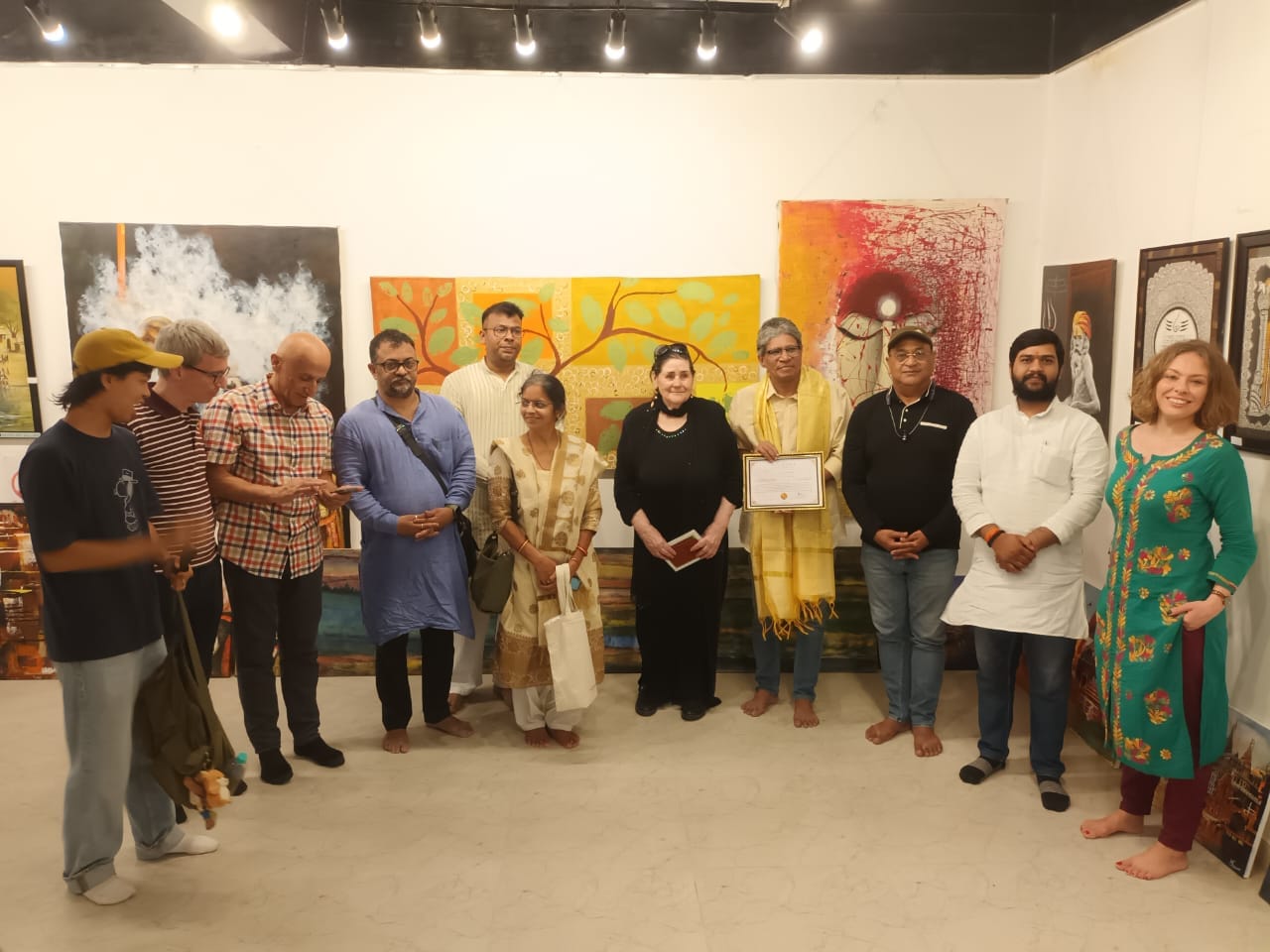
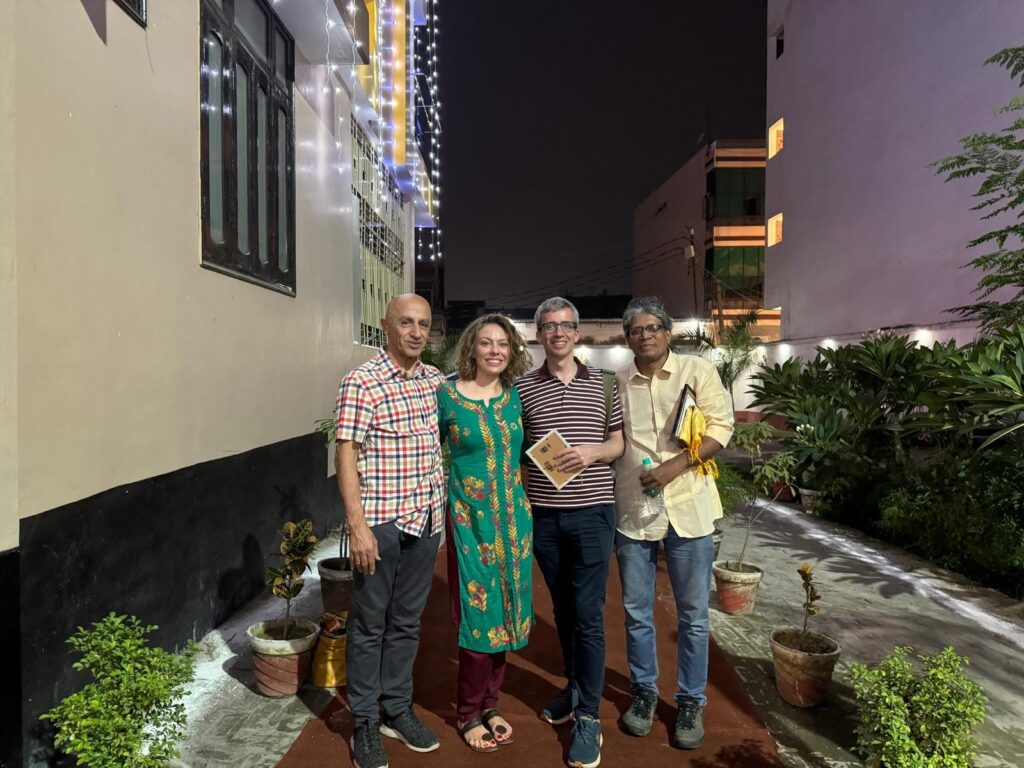
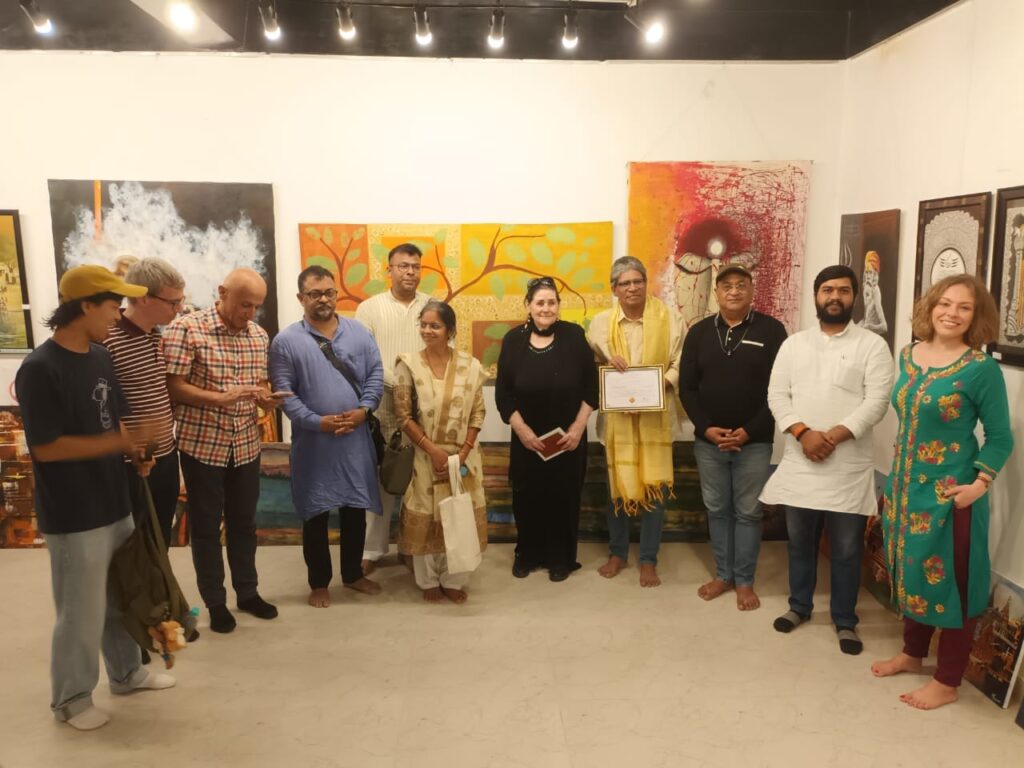
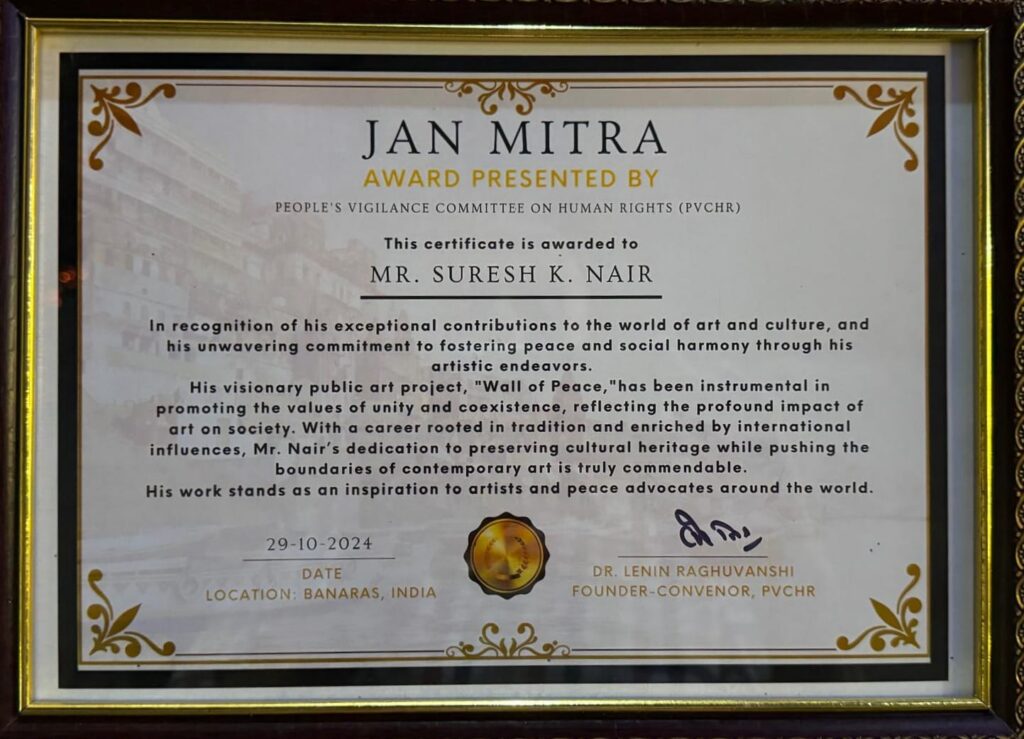
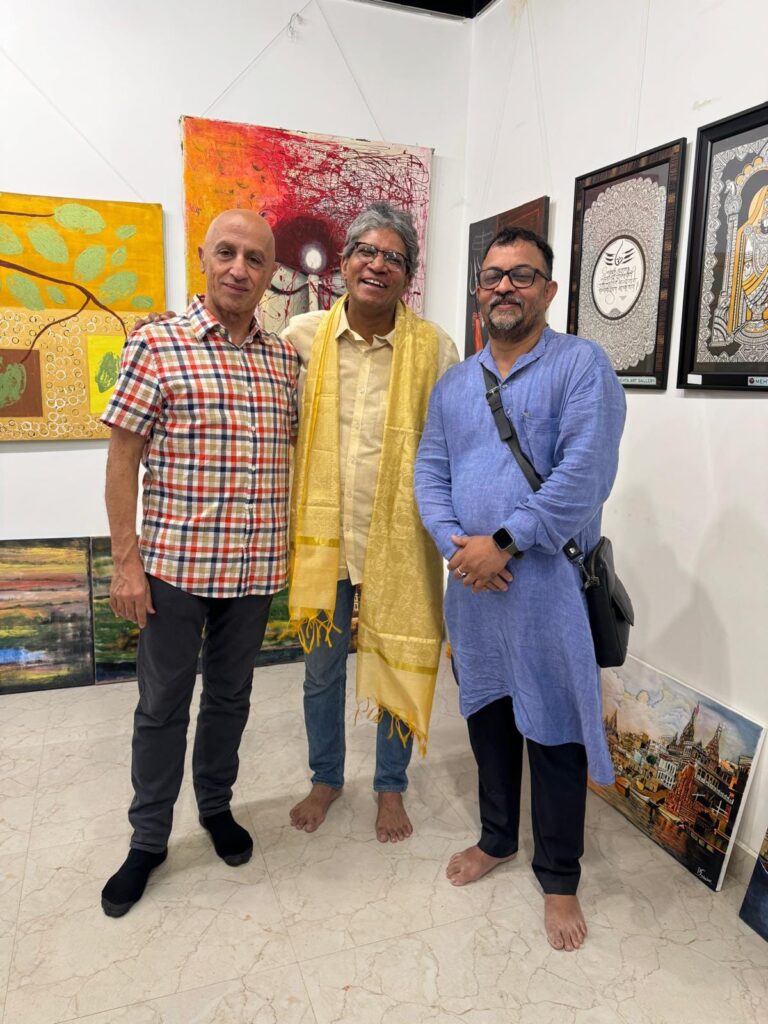
This certificate is awarded to Mr. Suresh K. Nair in recognition of his exceptional contributions to the world of art and culture, and his unwavering commitment to fostering peace and social harmony through his artistic endeavors. His visionary public art project, “Wall of Peace,”has been instrumental in promoting the values of unity and coexistence, reflecting the profound impact of art on society. With a career rooted in tradition and enriched by international influences, Mr. Nair’s dedication to preserving cultural heritage while pushing the boundaries of contemporary art is truly commendable. His work stands as an inspiration to artists and peace advocates around the world. Helma Ritscher, Chairwoman of the Indo-German Society of Remscheid, Germany presented ths prestigious award to the Mr. Nair. The event was graced by Dr. Lenin Raghuvanshi, Founder and Convenor of PVCHR; Prof. Chawky Frenn, Associate Professor at George Mason University and Fulbright Scholar at Banaras Hindu University, Smt. Shruti Nagvanshi, Shri. Direndra Sisodia, Shri. Amit Kumar founder of Mehta Art Gallery and other eminent dignitaries at Mehta Art Gallery, Varanasi, Uttar Pradesh, India.

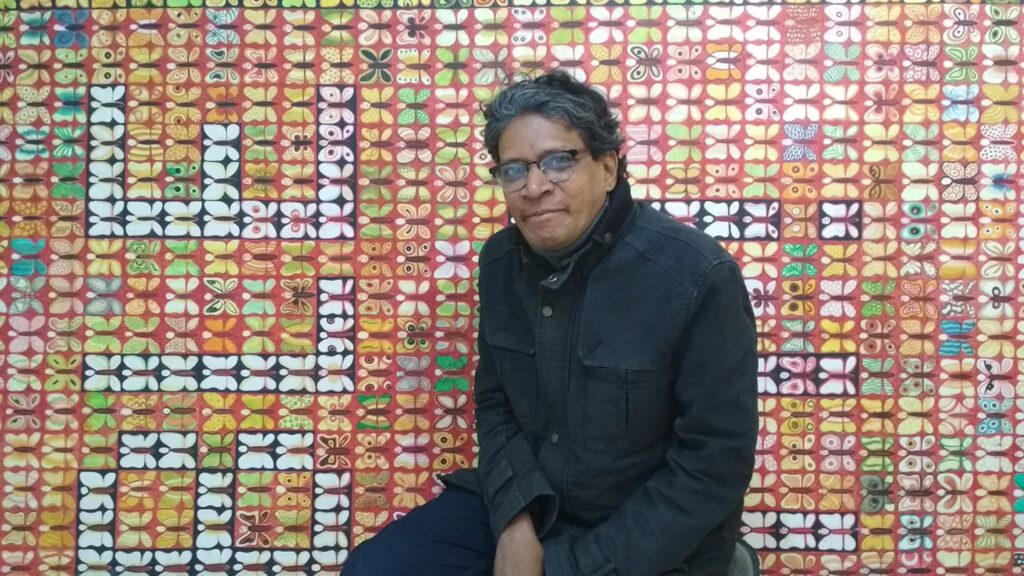
Brief about, Mr. Suresh K. Nair is a contemporary Indian artist from Kerala, renowned for his murals and fine art that merge traditional Indian styles with modern techniques. He is recognized for his expertise in mural art, which is deeply rooted in Kerala’s classical painting traditions, but his work often carries a unique, contemporary expression. Nair’s art frequently reflects themes of Indian mythology, spirituality, and social issues, showcasing a blend of vibrant colors, detailed patterns, and a strong narrative style.

He studied at Institute of Mural Painting, Guruvayur and Visva Bharati University, Santiniketan, and his murals have gained widespread appreciation, not only in India but also internationally, as he has contributed to various public art projects, exhibitions, and workshops worldwide.

Nair’s contributions to mural art have helped revitalize and modernize this ancient art form, while he remains dedicated to preserving Kerala’s rich artistic heritage. His work often explores complex themes with sensitivity, and he is celebrated for creating art that bridges cultural tradition and modern thought.

The “Wall of Peace” by Suresh K. Nair is a remarkable mural installation that he created at the Government Vocational Higher Secondary School in Cherpulassery, Kerala. Completed in 2013, this mural is one of his most ambitious projects and serves as a powerful visual representation of harmony, tolerance, and unity. Spanning around 1,200 square feet, it combines traditional Indian mural techniques with modern themes, depicting figures and symbols that reflect values of peace and coexistence.

The mural showcases diverse cultural and religious symbols, blending together images of saints, spiritual figures, nature, and mythological elements. Nair designed the mural to be a source of inspiration for students and the community, reinforcing values of non-violence and compassion. It includes imagery like the Buddha, Mahatma Gandhi, Mother Teresa, and other icons of peace, alongside intricate, nature-inspired motifs.

Through the “Wall of Peace,” Nair emphasizes the importance of art in educational spaces as a way to inspire young minds and promote positive values. This mural has become an iconic piece, admired both for its artistic merit and its message, and it represents Nair’s commitment to using art as a means of social and moral engagement. The “Wall of Peace” is not only a work of beauty but also a testament to Kerala’s rich mural tradition, reinvented to address modern social ideals. To know more: https://wallofpeace.in/

Submit Your blog/articles/Write-up

Love to write on art & culture, join us and send your blog/articles/WRITE-UP, we will make it featured on Mehta Art Gallery Official Website and social media.

Submit here or you can send at info@mehtaartgallery.com

    The Essence of Life: Art

    By: Amit Kumar

    It gives meaning to your life and you will never be alone if you are an artist.

    Art gives an inner peace of mind.  From art you can search yourself and you can tell your life story, your thoughts, your vision through colors on canvas let everyday people find themselves by seeing the art.

    In this frenetic world, people are forgetting about themselves and too many are running, often blindly, to earn a livelihood, earn money.  Emotionally and tragically physically people kill and hate one another to chase after money.  Art, alone, has the power to save our virtues.  People must increase their awareness regarding art and explore and read the art and the visions of artists.  Artists always create works which relate to society and culture en masse.  It depends on individual thought as to what was actually visualized. Art serves as communication for the improvement of social relationships through greater understanding of human experience. Art is society’s greatest cultural university that is open to all.

    The purpose of art is washing the dust of daily life off our souls. –Pablo Picasso

    Art is not just colors or thoughtless decoration.  It is the feelings and emotions of artists who created works drawn from their souls with intentional meaning.  After a work is completed, its interpretation is out of the artists’ hands literally.  The viewing public can then see and gain insights by seeing their own lives in it and find solutions as well.

    “Light and shadow, color and form, texture and intensity, representation and expression; these are the ways that art speaks to us”.

    Ascetics is just one of the principles of art.  Yet, what is pleasing to one person is not the same to another.  Works by Hieronymus Bosch appear as if Salvador Dali was having a terrible day.  Yet, both artist’s styles invite discussion, and provocation.  To me this is the essential principle of art: provoke thought!

    Putting brush in paint to canvas or whatever preferred medium is not the only art.  There are many works of art that appear naturally: a rose, a waterfall, a magnificent mountainscape, an archway created by wind, rain and erosion, to mention but a few.  In all its various glories, visual art is a feast for the eyes and soul.  This is when the artist and the viewer are closest to each other.  One having produced a work from the mind, the other determining its merits in theirs: a dialog of the minds.

    Despite the perception that the skills to create art are innate – we are born with it – the practice, failures, learning from failure, the successes are all integrated due to the diligence of the artist.  Trial and error is not innate, it’s takes many hours, years of study and practice.  To aid in the dialog of the minds is creativity.  The unspoken bond between artist and audience.  The greater appreciation of art can be reinforced with education by the audience, but it is not essential.  A higher level of education can help a viewer or critic articulate the merits or demerits of a work.  But, the perception of beauty is not solely driven by education.  In the end, it’s still a “gut feeling” regardless of how much or little schooling by the viewer.

    An emotional transformation “takes over” the consciousness of an artist when working.  Pulling on many emotional, mental and visceral threads, we go to that special place in our minds/souls to create art.  Intentional or not, somewhat trance-like, there is a powerful meditative level that artists reach to produce our works.

    The greatest service of art is the betterment of humanity by its astonishing power to communicate, to unite, to divide, however always stimulating communication.  Which is quite amazing seeing as pictures do not talk or do they?

    Art Vs Vote: A big threat for the real Artists

    By: Amit Kumar

    Far too often, I see posts and messages in my inbox demanding votes to score a win on many websites.  Participants and all their colleagues, friends and relatives on social websites demanding votes to make them win and trying to force us to be proud in their machinations. Those who are doing, unwisely think that they are supporting anyone.  In reality, they all are indulging in some wrong doing and manipulation in voting, this causes a corrosive, corruptness which affects the process and the artists specifically.

    • It’s simply begging for votes to get an empty win because they actually don’t have true confidence in their own art and creations.  That’s why this continues by amateur artists who claim to be a professionals.
    • This lame manipulation prevents the viewing public and other artists from seeing the real works of others who participate there.  Most voters don’t actually see or care about the work of that person.  They support friends’ work out of personal loyalty, not on the merits of the work itself.  This will continue to degrade the overall quality of art as votes are meted out on personalities, rather than the merits of the works of art.
    • The unfeeling face of politics is not fit to judge a painting.  More votes does not mean better art.  The political-art crowd is making this a filthy endeavour.
    • Participants who are in a race to get more and more votes for themselves often forget about their art, they are simply in a race to defeat another artist, often forsaking long-term growth in style and quality for the mere bauble of popularity.  This blind chase has led to polluting of art in their ignorance.
    • Artists has few demands for anything in this materialistic world, they just rely on supplies for their work and they are know then by seeing their work themselves.  A true artist need not force others to see their works.  A true artist will have his/her work sought out based on the merits of the work itself, not whose friend, brother, uncle, or aunt who voted for them.
    • Art and artists should be open and every artists has the full right to have their woks viewed in front of all, then people can judge and select best one which really deserves the acclaim: Not just by an artful hustler who just own some votes through some networks and with help of friends, colleagues or relatives.

    “BE PURE AND BEHAVE AS A REAL ARTIST”

    Why I Became An Artist?

    By: Amit Kumar

    Please allow me to reveal a truth about, why I became an artist, started painting and chose this as my career and my livelihood. In school at that time, I loved and enjoyed painting art works and won many competitions at school level. At that time I knew in my soul that this was going to be my future life and accepted it as my career.

    After school I took admissions for graduation to higher studies and moved out to another city. With a myriad of thoughts at the time, I forgot about painting, but still loved to do any artistic work whenever it came across in my way like in any function in college or in hostel. In my final year, I still didn’t know where I was going with my art, but cleared my mind knowing that I had to complete my Master of Business Administration (MBA) and then do a job for some time and then start something new.

    I joined another college for higher study and started my study and completed it in two years.  During these two years I started painting some and also exhibited in a show in the college auditorium with huge collections and also got a placement with a good package.  Upon joining an established organization, I started going to the office and lived life with a simple same routine day after day.  I didn’t enjoy it.  After sometime, I seriously questioned what I am actually doing, for this I was definitely was not born.

    At the same time, I saw many problems in society whether on social networking sites, on news, or on my ways when traveling anywhere, I saw many problems like poor people begging, humans just ignoring each other, caring not at all if anyone dead on road in accident, old person lying on road, no food to eat for people, small children begging on street.  Lots of problem I observed and sometimes I felt terrible and ask from deep within myself: Who am I?  What is my role on this earth?

    With many thoughts and imaginations I started to paint and to live in my own way and in that I felt free from everything and also realized that to be free and happy you have to live with your passion.  I became an artist and also planned to open my own art gallery to support many artists like me and other professionals.  Today, personally, artistically, and professionally, I am growing and feeling satisfied that I am doing what I want and leading my life and supporting many people without any exception and this will I do for my whole life.  My dream is to set a platform for all from which everyone can get whatever they want in the art field.

    Can Art Save Humanity?

    By: Amit Kumar

    One question that raises three more.  What is art?  Can it help save humanity? Is humanity worth saving?

    My answers come from personal experience and observation, readings (books), and other information gathering methods that don’t involve the Internet or Google.  Yet, without the Internet, it is unlikely you would be reading this, as I hope you are.

    But, in researching a recent article about beauty being in the eye of the beholder, the phrase on one website attributed it to Plato.  Finding accurate, reliable information is an art form.  Journalists in general, need at least two attributable sources, often more depending on the depth and scope of the story.

    The answer to the latter question is the easiest.  An emphatic yes!   As a member of humanity, I am a very big fan of us humans – flaws and virtues included.

    What is art is very subjective.  If viewed by moneys earned, except for two paintings sold to his brother Theo, Vincent Van Gogh was a dismal failure. His works now sell in the ten of millions of dollars, but in his time, he failed. So, that can’t be the sole touchstone for art’s value or what art is.  Volunteering to teach someone your art is self-less, but extremely self-nourishing.  What was once called sharing.  I’ve read in previous responses that art is writing, painting, performing, sculpting – “refined” skills.  What about tradespeople?

    If you have ever seen the gardens at Alhambra, plumbing is certainly an art form.  The pyramids certainly display the stone mason‘s art and skill.  As much as writers get writer’s block, I’m sure stone sculptors, even Michelangelo, got sculptor’s block (pun, partially intended).

    Art reflects life, that’s got to be it.  Or Art is love, or to Love is an art. Or, or . . . .  Art allows us to peer into our souls and briefly into the artist’s whether painter, dancer, welder, or plumber.  Art even at it’s worst, inspires debate, dialogue.  That’s it!  Art, whatever its form, is about communication. With visual art no language or communication barrier exists, instant translators are not needed.  Art evokes emotions – good and bad.  Aside from food, we humans feed off those emotions.  That, to me, is how art helps to save humanity.  We’re reminded that we’re only human, which is as good a starting point as possible.  We can always strive to do better.  Art is just one of many ways we can.

    Forgery is an Art

    By David Dollard

    Forgery is an artistic word for theft, fraud, counterfeiting.  The complete list of synonyms is much longer and grows more pejorative.

                Searching for “Counterfeit” on WikiP, a superb moment of clarity was reached, not quite an epiphany, incredibly ironic though.  At the bottom of the “Counterfeit” page under the header EXTERNAL LINKS, sub-head Anti-counterfeiting, a link appears for International Authentication Association (IAA).  It leads to a ghost site – a counterfeit with the banner: “BUY THIS DOMAIN the domain lmnopqrst.xxx may be for sale by its owner.”  One click and it leads to a front for a domain names website that will sell you the domain name for IAA.  You could be the proud owner and curator of IAA for a  bid “above the seller’s minimum threshold of 500 USD”.  The “seller’s” is the domain names website!  Who actually created the page?  Was it just the domain-selling website?  A fake link on the “Counterfeit” page: Hiding in plain sight, one of the the cornerstones of forgery.

                A pastiche courtesy of Elizabeth Barrett Browning, “How many ways can I forge thee?  Let me count the ways.”  The first two examples that lit my brain’s light bulb were money and paintings.  Silly me!  If it can be made, someone can forge it.

                A brief accounting: monies, paintings, sketches, weights and measures, authentications, clothing, machine parts, tabletop counters, clothing, drugs (legal and illegal), any consumer goods, archaeological finds, stamps, and history books.  The basest and cruellest forgery now involves the stealing of a person’s identity, creating a de facto other person: Identity Theft.

                When did the first forgery take place?  The Shroud of Turin is cited often, as are copies of the woodcut engraving plates of Albrecht Dürer.  Now, a little apocryphal history.  A cave man finds a piece of flint while out walking.  In picking it up, he slightly cuts himself.  After the “ouch” wears off, he begins to cut small branches and notches in wood.  Upon returning to the community enclave someone asks, “What have you got there, Art?”  “A new cutting tool I made,” Art replies.

                Art was now in a bind, he had to create what he found.  While out testing how to make the new cutting tool, he was overseen by Sham, who produces a workable blade and several more higher quality blades.  Sham decides to rename (re-brand) the cutting tool as Blade.  “I’ve made a Blade!” he trumpets to the enclave.  Art is not happy, he “found/made” the cutting tool, he should get full credit.

                Ego is a powerful force in all of this then, now, and in the future.  Whatever the work, we invest part of ourselves in its creation.  We expect some emotional/financial return on our mental and physical investment.


           Using the Internet, accrued knowledge from educational and personal sources (many from real paper books) are the basis for the research on this article.  When struggling for ideas, I turn to the dictionary (paper version).  Leafing through the pages looking for the correct spelling or definition of a word I’m looking for, I learn new words.  My spiffy 1987-edition of Merriam-Webster’s Ninth Collegiate dictionary lists in order:

    – forge
    – forger
    – forgery
    – forget

                The last two words struck me.  If you’ve been the victim of a forgery, you don’t forget!.  And forgery itself: Bakers works in a bakery, shouldn’t forgers work in a forgery?  That last sentence plays too fast and loose with the definitions.  However, new words and definitions are often cobbled together from existing lexicons.  That’s not forgery?

                Verifying the authenticity of any art work is highly ego-centric.  Some one, an individual, must “sign off” on authenticity, an “expert”.  A word similar to art: over time both have had their values as emotional and mental currency diluted by their fecundity.

                The experts with educational letters after their names often have the most to lose by verifying a fake, or faking a verification.  Their egos are heavily involved; reputations to lose and more(?) importantly money.  Once that covenant of trust has been broken it is nearly impossible to repair.

                In keeping this from becoming a tome, some brevity.  Two short interjections: John Drewe and Han van Meegeren.  Occasionally, even the experts go along with the con for their own reasons.

                From the beginning of the use of weights to measure quantities in exchange for barter or money,  some unscrupulous individuals began to lessen the actual weight by removing (shaving) parts off the original, creating a “knock off” weight.  Knock off some weight for greater return.

                Now artists, inventors, and creators are provided protection by a myriad of organizations: The World Intellectual Property Organization, the International Organization for Standards, and The International System of Units to barely skim the surface.  The enacting of new local, federal, and international laws; re-writing them to keep pace with the continually expanding varieties of fraud, counterfeiting, etc., which introduced the concept of Intellectual Property Rights as a legal, potentially punitive measure to address “philosophical” debates.

                What turns learning and ‘borrowing’ into forgery?  Intent!  When the student of any art learns from her/his teacher/master, the student may work at finding individual style by variations on the original.  It becomes a moral and legal issue when those works are attempted to be passed off as originals with forged signatures and style.  The original artist’s trademarks.  Trademarks?  I’m not delving deeper into guilds.

                As simply a moral issue, regardless of law, though much of law is derived from “a common morality,” forgery is an art: A corrupting, erosive, divisive art.  It is wrong.  Can anyone honestly admit they have never participated in forgery or copyright infringement.  Download an album or song from YouTube and you have.  I have.  Primarily to replace purchased CDs that I previously downloaded, but not all.  I know that the original artist won’t receive a cent from my download, that is wrong morally and maybe legally.  I won’t be re-selling it.  A little conscience salve.  That’s the rub!  Ego-driven conscious omission.

    The greatest losers to forgery are the artists (of all styles) who work and dedicate their lives and creative energy to pursuing their art, desire, calling to produce their own original works.  To have those talents, skills, and hopes stolen by a charlatan for emotional/monetary profit by misrepresenting them is the act of a coward.  Wrote myself into a corner here.  Am I a coward, an honest coward, or a forger?

    A fitting epilogue from H. L. Mencken: “When somebody says it’s not about the money, it’s about the money.”

    How can art change the world and help to save the humanity?

    David Dollard, Word Smith and Phrase Juggler

    One question that raises three more.  What is art?  Can it help save humanity? Is humanity worth saving?

    My answers come from personal experience and observation, readings (books), and other information gathering methods that don’t involve the Internet or Google.  Yet, without the Internet, it is unlikely you would be reading this, as I hope you are. 

    But, in researching a recent article about beauty being in the eye of the beholder, the phrase on one website attributed it to Plato.  Finding accurate, reliable information is an art form.  Journalists in general, need at least two attributable sources, often more depending on the depth and scope of the story.

    The answer to the latter question is the easiest.  An emphatic yes!   As a member of humanity, I am a very big fan of us humans – flaws and virtues included.

    What is art is very subjective.  If viewed by moneys earned, except for two paintings sold to his brother Theo, Vincent Van Gogh was a dismal failure. His works now sell in the ten of millions of dollars, but in his time, he failed. So, that can’t be the sole touchstone for art’s value or what art is.  Volunteering to teach someone your art is self-less, but extremely self-nourishing.  What was once called sharing.  I’ve read in previous responses that art is writing, painting, performing, sculpting – “refined” skills.  What about tradespeople?

    If you have ever seen the gardens at Alhambra, plumbing is certainly an art form.  The pyramids certainly display the stone mason’s art and skill.  As much as writers get writer’s block, I’m sure stone sculptors, even Michelangelo, got sculptor’s block (pun, partially intended).

    Art reflects life, that’s got to be it.  Or Art is love, or to Love is an art. Or, or . . . .  Art allows us to peer into our souls and briefly into the artist’s whether painter, dancer, welder, or plumber.  Art even at it’s worst, inspires debate, dialogue.  That’s it!  Art, whatever its form, is about communication. With visual art no language or communication barrier exists, instant translators are not needed.  Art evokes emotions – good and bad.  Aside from food, we humans feed off those emotions.  That, to me, is how art helps to save humanity.  We’re reminded that we’re only human, which is as good a starting point as possible.  We can always strive to do better.  Art is just one of many ways we can.